Turning Product Interest Into Product ConfidenceCopy link to this section
CGP needed more than a simple product showcase for the Eleanor chair. They needed an interactive experience that could help customers understand the product, explore their options, and feel more confident before taking the next step.
For a product with material and colour choices, the challenge is not simply showing what is available. It is helping the customer understand how those choices work together. A static image can show one version of a product. A gallery can show several. But neither gives the customer the feeling of building something that belongs to them.
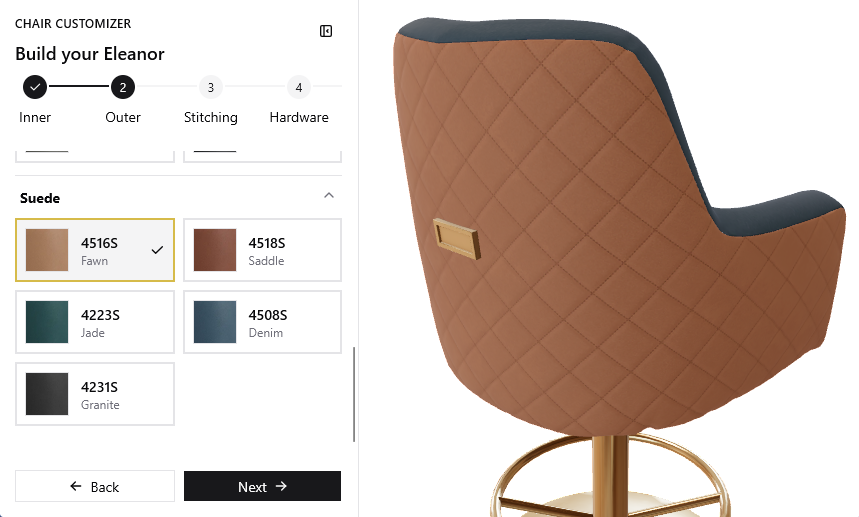
The goal was to create a configurator that worked as a marketing experience, a product education tool, and a sales support system. Customers could explore the chair visually, customise key finishes, orbit around the model, and create a version that reflected their own preferences.
The experience was designed to move customers from passive interest to active consideration.
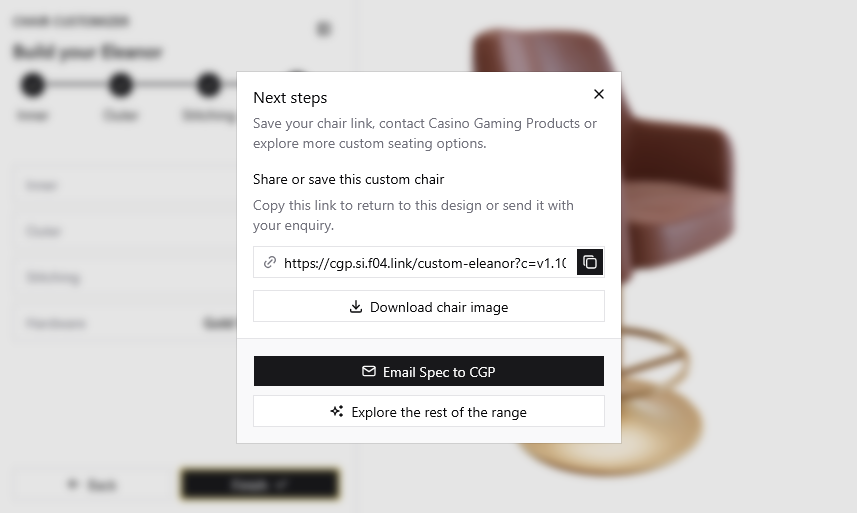
By the end of the configurator, users could reach out to the seller, export an image for marketing use, or generate a quick link to share their design. This transformed the experience from a visual demo into a practical sales tool, helping customers arrive at the conversation with a clearer understanding of what they wanted.
Why Personalisation Changes the Way People EngageCopy link to this section
Personalisation changes the psychology of a product experience. When a customer can make choices, test combinations, and see their preferences reflected instantly, they are no longer looking at a generic item. They are beginning to form a connection with a specific version of that item.
That distinction is important.
A product page asks the customer to evaluate what already exists. A configurator invites them to participate in creating something. Even when the options are simple, that sense of participation can make the experience feel more meaningful.
For Eleanor, the key choices were materials and colours. These are highly visual decisions, and they are often difficult to make through description alone. A customer may understand the name of a finish, but still struggle to imagine how it will look on the chair, how it will interact with other materials, or whether the final combination feels right.
The configurator reduced that uncertainty by making the decision visible.
A product configurator does not simply show options. It helps customers understand the consequences of their choices.
Instead of relying on imagination, users could test combinations directly. They could see the chair update, rotate around it, compare the effect of different choices, and build confidence in the result.
The Value of Seeing Before AskingCopy link to this section
Many sales conversations begin with uncertainty. A customer may like the product but not know what they want. They may have questions about finishes, combinations, proportions, or how a certain material will look in context. That uncertainty can slow down the conversation, or worse, prevent the enquiry from happening at all.
The Eleanor configurator helped address this by giving users a clearer starting point.
Before reaching out, customers could explore the product on their own terms. They could experiment without pressure, refine their preferences, and arrive with something tangible: a saved design, an exported image, or a shareable link.
This matters because a better-informed customer creates a better sales conversation. The seller does not have to begin from a blank slate. They can respond to a specific design, discuss practical next steps, and guide the customer from interest toward decision.
The configurator became a bridge between browsing and buying.
It gave customers a way to build confidence privately, then carry that confidence into a conversation with the seller.
Designing for ExplorationCopy link to this section
The configurator was built around a simple idea: customers should be able to understand the chair visually, quickly, and from every angle.
The experience allowed users to customise key materials and colours, then orbit around the model to inspect the result. This orbiting camera was not only a visual feature. It was a tool for understanding.
A chair is a three-dimensional object. Its shape, proportions, and material relationships change depending on the viewing angle. A colour that feels subtle from the front may become more prominent from the side. A material choice may feel different once the user sees how it wraps around the form.
By allowing users to rotate around the model, the configurator made the product feel more complete.
The more confidently a customer can inspect a product, the more confidently they can imagine owning it.
This is especially valuable for products where finish, detail, and personal taste play a major role. A configurator gives the customer time to look closely, compare options, and make decisions with more confidence.
From Product Viewer to Sales ToolCopy link to this section
A common mistake with digital product experiences is treating them only as visual showcases. They may look impressive, but they do not always support the next step in the customer journey.
The Eleanor configurator was designed to go further.
At the end of the experience, users could export an image, generate a quick link, or reach out to the seller. These features made the configurator practical. It was not only a place to explore the chair. It was a way to carry that exploration forward.
The exported image gave users something visual they could save or use in marketing contexts. The quick link made sharing easy, allowing a customer to send their design to someone else without having to describe every choice manually. The contact pathway gave the seller a warmer and more informed enquiry.
Each of these features reduced friction.
Instead of asking the customer to remember what they selected, explain it in writing, or restart the conversation later, the configurator preserved the design as a usable reference point.
That is where the experience became commercially valuable.
It supported the moment after interest, when the customer is ready to move from exploration into action.
Making the Product Feel More PremiumCopy link to this section
Premium product experiences are not only about visual quality. They are about clarity, control, and confidence.
A high-quality configurator can elevate the way a product is perceived because it signals that the product has been considered from the customer’s point of view. It says: this product has options worth exploring, details worth understanding, and a buying process worth making easier.
For CGP, the Eleanor configurator helped position the chair as something more considered than a standard product listing. The customer was invited to slow down, explore, and engage with the design in a more deliberate way.
That kind of interaction can change the tone of the sale.
Instead of presenting the chair as a fixed object, the experience presented it as a product with possibilities. It allowed the customer to take part in shaping the final result, which made the experience feel more personal and more premium.
When customers can shape the product visually, the experience begins to feel less like browsing and more like ownership.
This is particularly important for furniture, interiors, and design-led products, where emotional response plays a large role in decision-making. People are not only buying function. They are buying fit, taste, identity, and confidence.
Reducing the Burden on ImaginationCopy link to this section
One of the biggest barriers in custom product sales is imagination. Customers are often asked to picture a final result based on small swatches, product names, sample images, or verbal descriptions.
That creates risk.
The customer may hesitate because they are unsure. They may choose a safer option because they cannot visualise a bolder one. They may delay the enquiry because they still need to think about it. In some cases, they may walk away because the decision feels too abstract.
The Eleanor configurator reduced that burden by making each choice visible.
Rather than asking users to imagine how a material and colour combination would look, the experience showed them. That changed the role of the customer from interpreter to decision-maker. They could respond to what they saw, adjust what did not feel right, and refine the design until it made sense to them.
This kind of immediate visual feedback is one of the strongest advantages of interactive product tools.
It turns uncertainty into exploration.
And when exploration feels easy, customers are more likely to spend time with the product.
A Better Starting Point for Sales ConversationsCopy link to this section
For the sales team, the value of the configurator was not limited to customer engagement. It also created better context.
A customer who shares a design link or exports an image is communicating more than general interest. They are showing a preference. They are revealing what materials they like, what colour direction they are considering, and how they imagine the final product.
That information can make the sales process more efficient and more personal.
Instead of asking broad discovery questions, the seller can begin with the design itself. They can confirm the customer’s choices, suggest refinements, answer specific questions, and guide the customer toward a more confident decision.
The configurator gave the sales team a stronger starting point: not a cold enquiry, but a customer with a design already in mind.
This is where interactive tools become especially powerful. They do not replace the human sales process. They improve the quality of the conversation before it begins.
Why This Matters Beyond One ChairCopy link to this section
Although this experience was created for the Eleanor chair, the same approach applies to a wide range of products.
Any product with visible options, personal preferences, finishes, materials, colours, accessories, layouts, or configurations can benefit from being made interactive. The more a customer has to imagine, compare, or personalise, the more valuable a configurator becomes.
Furniture is a natural fit, but the same logic applies to interiors, vehicles, retail displays, architectural products, commercial equipment, exhibition systems, homewares, lighting, and premium manufactured goods.
The underlying principle is simple: when customers can see their choices clearly, they can make decisions more confidently.
A configurator gives businesses a way to present variation without overwhelming the customer. It can simplify complex product ranges, make customisation feel enjoyable, and help sales teams capture more informed interest.
The ResultCopy link to this section
For CGP, we created an interactive product configurator that helped customers explore, personalise, and share their own version of the Eleanor chair.
The experience allowed users to customise key materials and colours, orbit around the model, export an image, generate a quick link, and reach out to the seller with a clearer sense of what they wanted.
The result was a tool that worked across marketing and sales. It made the product more engaging, helped customers understand their options, and gave the sales team better-informed leads.
Most importantly, it changed the way customers related to the product.
Instead of simply viewing the Eleanor chair, they could shape it, inspect it, save it, and share it.
For customisable products, that is the difference between showing what is available and helping customers imagine what is possible.