Making Safety Technology LegibleCopy link to this section
Geotab develops safety technology for trucks, operating in a category where the value of a product is often difficult to communicate at first glance. The most important benefit of safety technology is not always visible as a physical feature. It appears in context, timing, prevention, and the moments where a driver has to make sense of risk quickly.
That creates a specific communication challenge.
A technical explanation can describe the system, but it rarely communicates the lived value of the system. It tells an audience what the product does, but not necessarily what it changes.
The goal was not simply to show the technology. It was to make people understand why it matters.
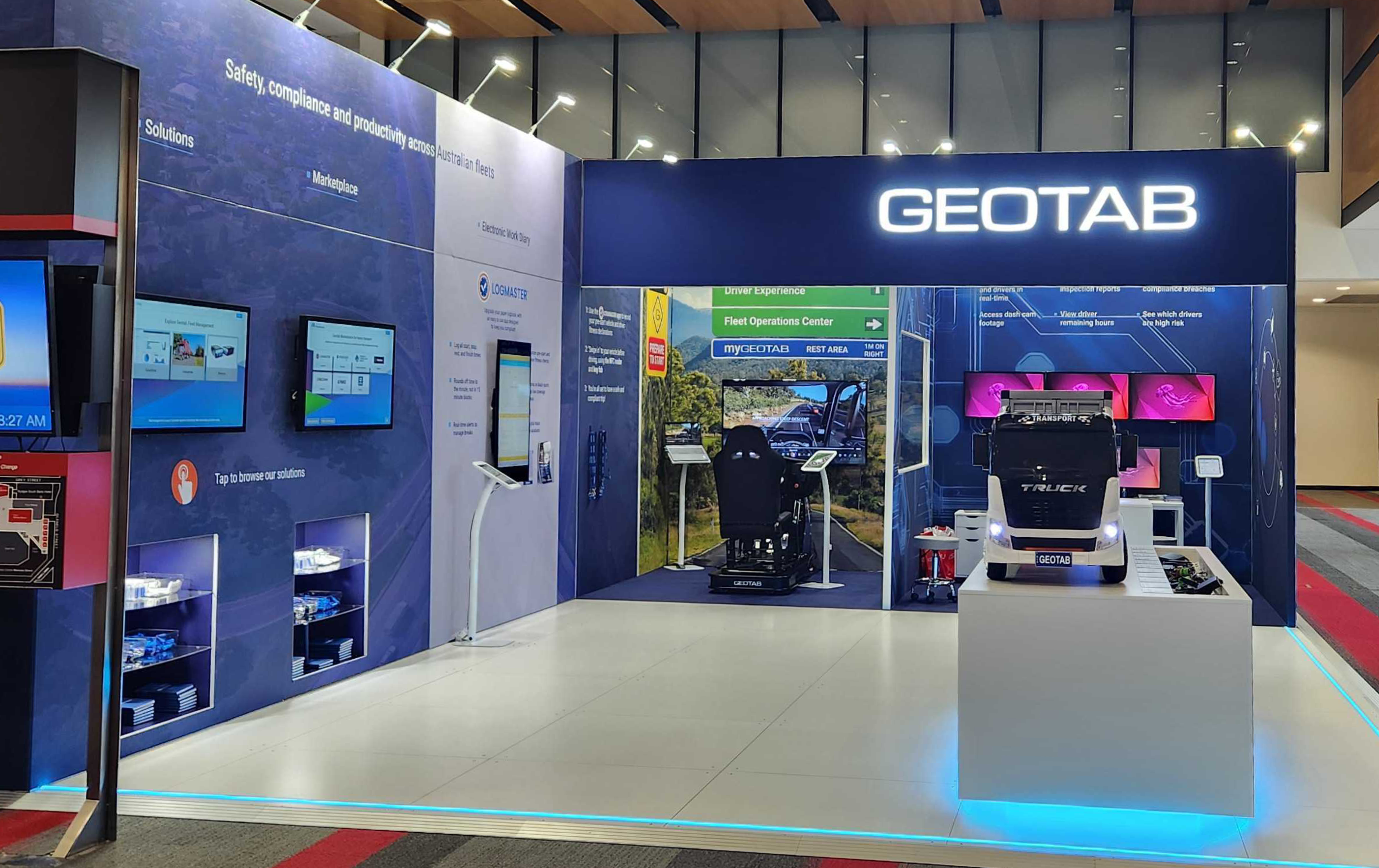
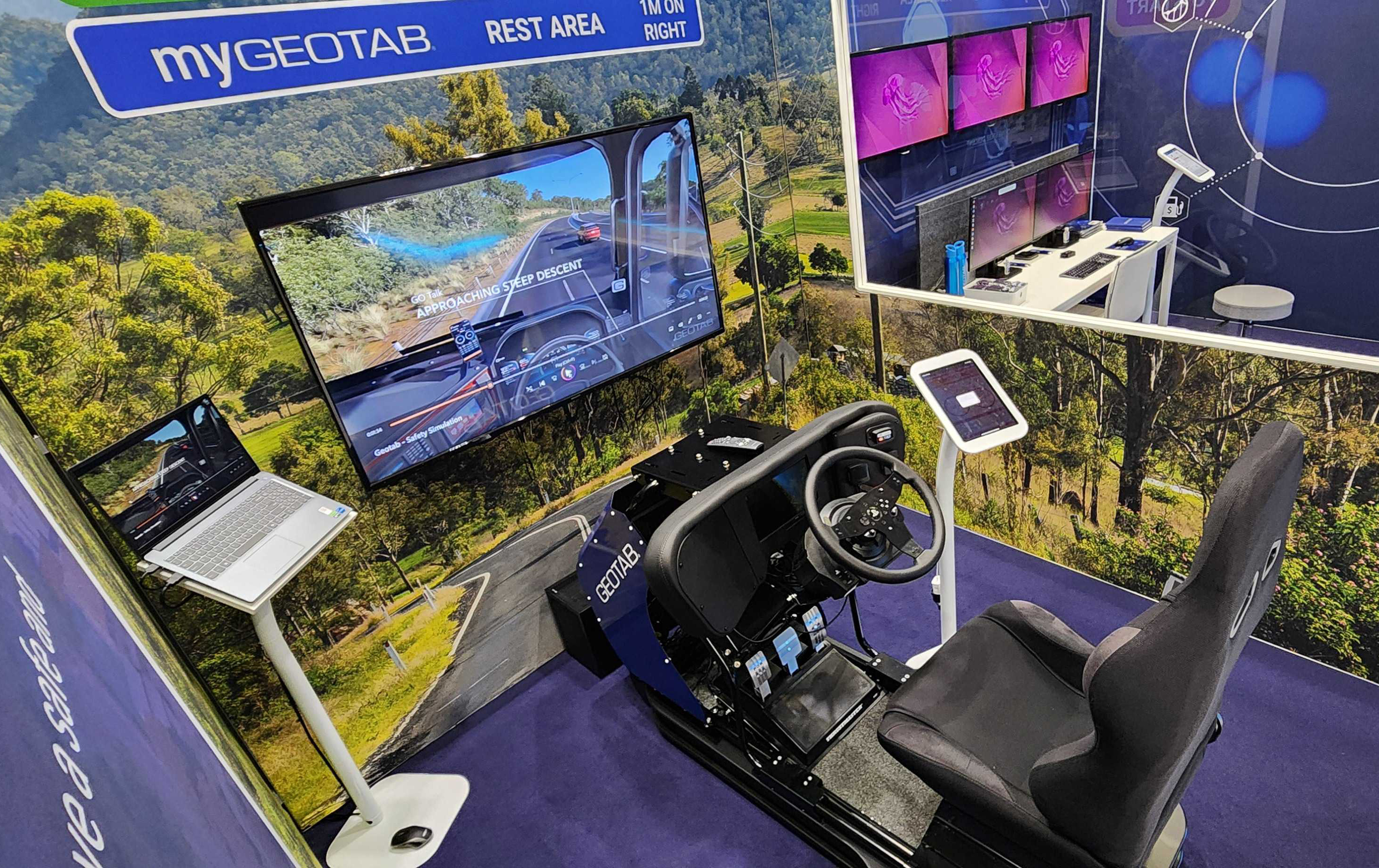
For this project, Geotab needed a presentation that made their safety technology immediately understandable, credible, and memorable. The solution was an animated product experience built around practical truck-driving scenarios, paired with a driver seat installation for use at a truck expo.
Attendees could sit down, enter the driving context, and experience the technology from the position where its value matters most.
The result was not simply a product video. It was a controlled, scenario-led demonstration designed to help people understand the product through context rather than description alone.
Why Context Matters for Complex ProductsCopy link to this section
Complex products often fail to land because they are presented in the wrong frame. A feature list asks the viewer to translate capability into value. A diagram asks them to imagine the product in motion. A sales pitch asks them to trust that the benefit will become clear later.
For safety technology, that gap is especially important.
The product is valuable because of what it helps prevent, detect, or clarify. Its impact is situational. To understand it properly, the viewer needs to see the conditions around it: the vehicle, the road, the driver, the hazard, the alert, and the outcome.
The Geotab experience was designed around that principle. Rather than isolating the technology as a feature, the video placed it inside practical driving moments where its purpose could be understood instantly.
The audience did not need to infer the value from a specification. They could see the value unfold.
A feature list explains capability. A scenario shows consequence.
This is where animated visualisation becomes a powerful tool. It allows a brand to compress complexity into a carefully structured sequence. The environment can be controlled, the timing can be precise, and the audience’s attention can be directed toward the exact moment where the product makes a difference.
In safety, training, transport, mining, medical, and industrial technology, that level of control is often critical. The product may be sophisticated, but the first impression must be clear.
The Science Behind Scenario-Based UnderstandingCopy link to this section
The experience was built on a principle that is well established across learning design, cognitive psychology, and simulation-based training: people understand complex information more effectively when it is structured around meaningful context.
A product feature presented in isolation has to be interpreted.
A product feature presented inside a scenario has a function, a consequence, and a reason to be remembered.
This aligns closely with research into multimedia learning and cognitive load. When visual information is sequenced clearly, it can reduce the mental effort required to understand a complex system. Instead of asking the viewer to hold several abstract ideas in working memory, a well-designed visual sequence shows the relationship between them.
In this case, the animation helped organise the viewer’s attention. It could show the driving environment, introduce the risk, reveal the technology’s role, and resolve the scenario in a way that felt coherent.
The experience was not trying to overwhelm the audience with information. It was designed to make the right information available at the right moment.
Premium product communication is not about adding more detail. It is about removing friction between the audience and the idea.
That distinction matters. The more complex the product, the more deliberate the communication needs to be.
The Role of the Driver SeatCopy link to this section
The driver seat installation was a crucial part of the experience because it changed the audience’s relationship to the content.
The viewer was not positioned as an outside observer. They were physically placed into the role of the driver.
That physical framing gave the animated video a stronger sense of relevance. Sitting in the seat created an immediate association with responsibility, attention, and control. It made the experience less like watching a presentation and more like entering a simulation.
This kind of embodied context is common in industries where performance, risk, and decision-making matter. Flight simulators, medical training environments, mining safety systems, and vehicle training tools all use physical or spatial framing to help people connect information with action.
The aim is not only to explain a process, but to make the learner understand where they sit within it.
For Geotab, the driver seat did that efficiently. It made the technology feel practical rather than abstract. It gave the audience a clear point of view. It also made the installation more attractive in a trade show environment, where participation can be the difference between being noticed and being ignored.
By placing the viewer in the driver’s position, the technology became easier to understand, easier to trust, and easier to remember.
Designing for Attention in an Expo EnvironmentCopy link to this section
Trade shows are high-noise environments. Attendees are moving between stands, scanning for relevance, comparing vendors, and absorbing more information than they can reasonably retain.
In that setting, a standard product video can easily become passive background content.
The Geotab installation was designed to create a stronger attention loop:
- The seat invited participation.
- The animation rewarded that participation with a clear product story.
- The scenario format made the message easier to follow.
- The physical setup made the experience memorable.
This is an important distinction in expo design.
Visibility is not the same as engagement.
A large screen can attract attention, but it does not guarantee understanding. A premium experience needs to move people from noticing, to engaging, to retaining.
By combining animation with a physical driver environment, the Geotab presentation created a more deliberate interaction. Visitors were not simply exposed to the brand. They were given a moment with it.
Thank you for the amazing work and we will be leveraging that material into our future events' activations.” - Lia Geraissate, Regional Marketing Manager - APAC
That response speaks to one of the strongest outcomes of the project: the material was not seen as a one-off expo asset, but as something with continued value across future brand activations.
That moment created a stronger foundation for sales conversations. Instead of beginning with an explanation of what the technology does, the team could begin with a shared experience: what the visitor had just seen, felt, and understood.
Why Animation Was the Right MediumCopy link to this section
Live action can be powerful, but it is not always the most effective medium for explaining safety technology. Real-world footage can be difficult to control, particularly when the goal is to communicate specific moments of risk, response, and system value with precision.
Animation allowed the experience to be designed with clarity.
The scenario could be simplified without becoming unrealistic. The timing of events could be controlled. The product behaviour could be highlighted without distraction. The visual language could remain polished, consistent, and aligned with the premium nature of the Geotab brand.
This is especially valuable when a product’s benefit depends on timing.
Safety technology often works in narrow windows of awareness and response. A few seconds can define whether a feature feels useful, urgent, or credible. Animation gives those seconds structure.
The final video was able to communicate practical driving scenarios while maintaining the clarity of a product demonstration. It balanced realism with focus, which is often where effective technical storytelling sits.
Animation gave Geotab control over the exact moment where the technology became meaningful.
From Product Explanation to Product ConfidenceCopy link to this section
The deeper purpose of the experience was to build confidence.
In B2B environments, especially around safety, technology, and fleet operations, confidence is not created by spectacle alone. It is created when the audience understands the problem, sees the relevance of the solution, and trusts the way it has been presented.
The Geotab experience supported that process by making the technology easier to interpret. It gave visitors a concrete reference point. It helped them understand the role of the system without requiring a dense technical introduction.
It also positioned the brand as thoughtful, polished, and capable of communicating complex ideas clearly.
That kind of presentation matters because it affects how a product is discussed after the event. A strong immersive experience gives people something specific to remember and repeat.
Instead of describing Geotab only as a provider of truck safety technology, an attendee could describe the moment they sat in the driver seat and saw the safety system play out in context.
That is a more useful memory. It is specific, experiential, and easier to carry into a later conversation.
Broader ApplicationCopy link to this section
Although this project was created for Geotab, the same communication strategy applies to many complex products.
Any business selling a technical, preventative, high-value, or hard-to-visualise solution faces the same challenge: the audience may not understand the value until they see the product operating in the right situation.
Immersive product visuals solve this by making the use case visible. They can show risk, movement, timing, decision-making, environmental context, and product response in a way that static content cannot.
They can also make a sales conversation more efficient by giving both the customer and the sales team a shared visual reference.
For companies in transport, mining, industrial technology, medical devices, safety systems, infrastructure, and training, this approach can be particularly valuable. It helps move the discussion from abstract capability to practical relevance.
The more complex the product, the more important it becomes to show the moment where it creates value.
The ResultCopy link to this section
For Geotab, we created an animated product experience that transformed safety technology into a clear, practical, and memorable demonstration.
Paired with a driver seat installation at a truck expo, the video gave attendees a way to experience the technology from the driver’s perspective and understand its value through real-world scenarios.
The outcome was a presentation that worked on multiple levels. It educated visitors, elevated the brand, supported sales conversations, and created a more memorable point of engagement in a busy expo environment.
Most importantly, it shifted the product story from explanation to understanding.
For complex technology, that is often the difference between being seen and being believed.